



Laser welding is widely used in automotive manufacturing to join metal components with high precision, speed, and consistency. From vehicle body assembly and EV battery production to electric motors and automotive electronics, it helps manufacturers improve weld quality, reduce thermal distortion, and integrate joining into automated lines.
As the automotive industry advances toward electrification, lightweight design, and intelligent production, laser welding helps manufacturers improve weld quality, reduce thermal distortion, and integrate joining processes into automated production lines.
Why Is Laser Welding Important in Automotive Manufacturing?
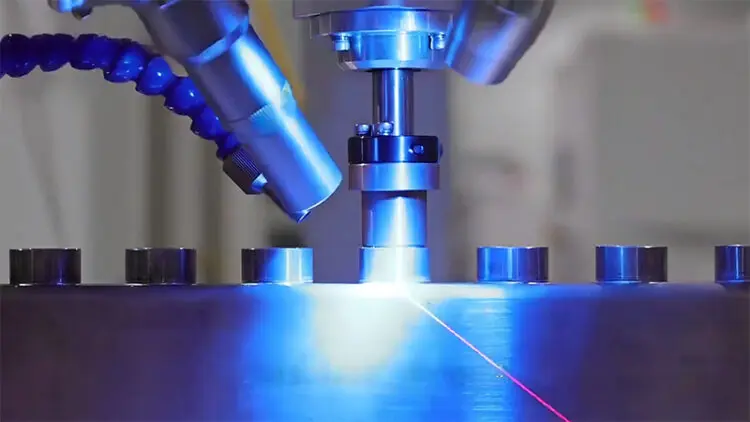
Laser welding uses a concentrated, high-energy laser beam to melt and join materials with precisely controlled heat input. As the automotive industry moves toward electrification, lightweight design, and intelligent production, this process gives manufacturers a repeatable, automation-ready way to produce strong, consistent joints at production speed.
High welding speed: Supports high-volume automotive production and shorter cycle times.
Precise heat control: Localized energy input helps minimize thermal distortion on thin or sensitive parts..
Consistent weld quality: Repeatable joining performance with narrow, uniform seams across batches..
Automation compatibility: Integrates cleanly with robots, vision systems, and production lines..
Reduced post-processing: Improved weld appearance can lower finishing requirements in suitable applications.
The actual results depend on material properties, joint design, and welding parameters.
Main Applications of Laser Welding in the Automotive Industry
1. Automotive Body Welding
Body-in-white (BIW) manufacturing is one of the most important application of laser welding. Modern vehicle bodies use high-strength steel, galvanized steel, and aluminum alloys to balance structural strength and lightweight design.
Typical applications include:
•Roof-to-body and door frame welding
•Side panel and floor assembly
•Tailored blank welding
•Structural reinforcement welding
Laser welding produces narrow, consistent weld seams while helping control heat input and dimensional deformation. When properly designed and validated, these joints support vehicle body integrity and manufacturing efficiency.
2. EV Battery Laser Welding
EV battery manufacturing requires reliable electrical connections and secure enclosures. Laser welding is widely used for precision joining of conductive materials and battery structures.
Key applications include:
•Battery tab and terminal welding
•Copper and aluminum busbar welding
•Cell connection welding
•Battery housing and cover welding
•Selected battery tray and cooling components
Laser welding enables localized heat input and precise processing of small components. Optimized parameters can help achieve low-resistance electrical connections and reliable sealing performance.
Because copper and aluminum have different physical properties, laser source characteristics, joint preparation, and process control are all important factors in achieving consistent results.
3. Electric Motor & Automotive Component Welding
Laser welding also supports the production of electric drive systems and precision automotive components. Typical applications include:
Electric motors: hairpin stators, motor terminals, and busbars.
Automotive electronics: sensors, connectors, camera components, and electronic housings.
Mechanical components: selected turbocharger parts, fuel system components, and cooling assemblies.
These applications often require accurate positioning, controlled heat input, and reliable joints that withstand vibration, temperature changes, or mechanical stress.
How Does Automation Improve Automotive Laser Welding?
Automated laser welding combines welding equipment, positioning systems, material handling, and quality monitoring to support efficient production. A typical system may include:
•Robotic welding and handling
•CCD vision positioning
•Automated loading and unloading
•Real-time process monitoring
•ntegration with manufacturing execution systems (MES)
These technologies reduce manual handling, improve process repeatability, and support production traceability.
Han’s Laser provides industrial laser equipment and automation solutions for manufacturers. Depending on production requirements, laser welding can be integrated with complementary automated laser processing lines.
Future Trends in Automotive Laser Welding
Lightweight materials: increasing use of aluminum alloys and high-strength steel.
EV manufacturing: growing demand for precise copper and aluminum welding.
Intelligent automation: wider adoption of robotic systems, vision positioning, and process monitoring.
Advanced laser technologies: development of beam shaping, wobble welding, and multi-beam processing for suitable applications.
Data-driven quality control: greater use of process data to identify abnormalities and improve production consistency.
These developments are expanding laser welding applications across conventional vehicles and new-energy vehicle manufacturing.
How to Choose an Automotive Laser Welding Machine
Selecting the right laser welding system requires evaluating the material, component design, quality standards, and production capacity. Manufacturers should consider:
•Material type and thickness
•Joint geometry and required weld strength
•Production cycle time and output
•Positioning accuracy and automation requirements
•Process monitoring and inspection needs
Application testing is recommended before equipment selection, particularly for dissimilar materials and safety-critical components.
Han’s Laser offers a range of laser welding machine for industrial manufacturing applications. The appropriate configuration depends on the workpiece, welding requirements, and automation level.
Frequently Asked Questions About Automotive Laser Welding
What is laser welding used for in automotive manufacturing?
—Laser welding is used for vehicle body components, EV battery connections, electric motors, automotive electronics, and precision metal parts.
Why is laser welding suitable for EV batteries?
—It offers precise energy control and localized heat input, making it suitable for battery terminals, busbars, and compatible battery enclosures. Proper process validation is essential for electrical performance and sealing reliability.
Which materials can be laser welded?
—Common materials include carbon steel, stainless steel, galvanized steel, aluminum alloys, copper, and nickel-based materials. Weldability depends on material properties, thickness, joint design, and process parameters.
Is laser welding better than traditional welding?
—Not for every application. Laser welding offers high speed, precise heat control, and automation compatibility, while conventional methods may be more suitable or economical for certain joints. The best process depends on production requirements and total cost.
Can laser welding be automated?
—Yes. Laser welding can be integrated with industrial robots, vision systems, automated handling, and process monitoring to support repeatable, high-volume production.
Conclusion
Laser welding has become an important technology in automotive manufacturing, —from vehicle body structures and EV batteries to electric motors and precision electronic components. Han’s Laser provides laser processing equipment and application-oriented solutions to to help you evaluate the right technology for your production line..
Explore Han’s Laser Welding Machines to learn more about available solutions.




 LET’S TALK


