



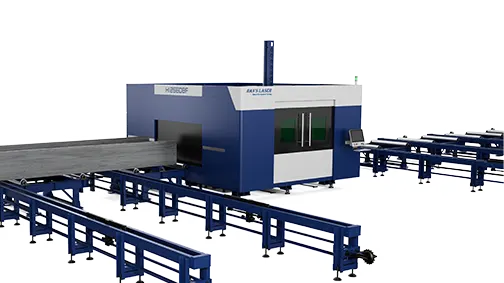


Which type of press brake is best for your production needs?
As sheet metal fabrication continues to evolve toward higher precision, greater automation, and improved energy efficiency, manufacturers are faced with an important question: Which type of press brake is best for their production needs?
Modern press brakes are no longer limited to conventional hydraulic machines. Today's market includes electro-hydraulic servo press brakes, hybrid servo press brakes, all-electric press brakes, automated bending centers, robotic bending cells, tandem press brakes, and heavy-duty bending systems.
Each technology offers unique advantages depending on the application, production volume, material type, and automation requirements.
In this guide, we'll explore the major types of press brakes available today and how Han's intelligent bending solutions help manufacturers improve productivity, accuracy, and operational efficiency.
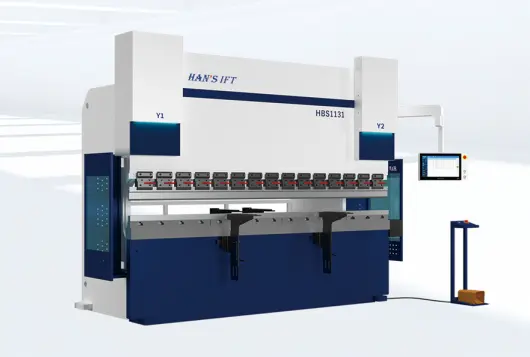
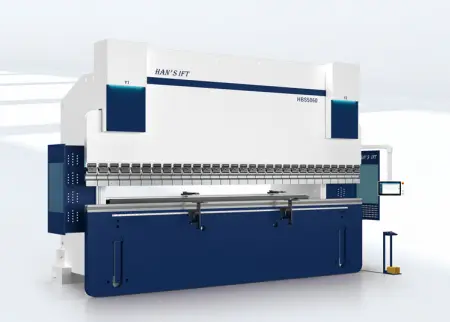
HBS Series: Electro-Hydraulic Servo CNC Press Brake
Best for: General Sheet Metal Fabrication and High-Precision Bending
Electro-hydraulic servo press brakes have become the industry standard for manufacturers seeking a balance between precision, flexibility, and productivity.
The Han's HBS Series Electro-Hydraulic Servo CNC Press Brake utilizes advanced servo-controlled hydraulic technology to ensure accurate synchronization and smooth ram movement throughout the bending process.
Key Advantages
•Integrated Hydraulic System:Delivers enhanced dynamic performance and improved productivity.
•Oil-Resistant Stainless Steel Split Tank:Reduces oil consumption while minimizing corrosion and valve clogging risks.
•Expanded Processing Capacity:Increased open height, throat depth, ram stroke, and back gauge travel support a wider range of applications.
•Robust Frame Engineering:FEA-optimized structure with annealing and vibration aging ensures long-term stability and precision.
Typical Applications
•Electrical enclosures
•Metal cabinets
•Agricultural machinery
•Construction equipment
•General fabrication workshops
For many manufacturers, electro-hydraulic servo technology represents the ideal combination of performance, reliability, and investment value.
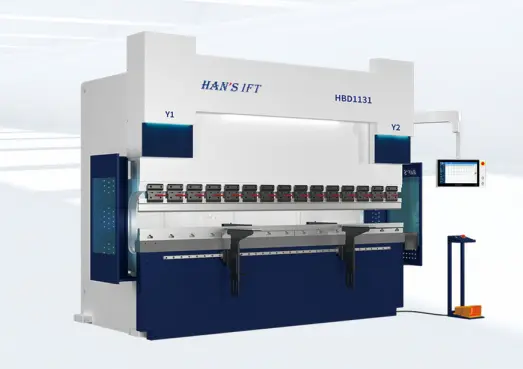
HBD Series: Dual Servo Hybrid CNC Press Brake
Best for: Energy-Efficient Manufacturing
As energy costs continue to rise, manufacturers are increasingly looking for solutions that reduce power consumption without sacrificing performance.
The Han's HBD Series Dual Servo Hybrid CNC Press Brake combines hydraulic power with intelligent servo drive technology to optimize energy usage throughout the bending cycle.
Key Advantages
•Dual-Servo Hybrid Technology:Delivers faster dynamic response and significantly improves production efficiency.
•Oil-Resistant Stainless Steel Split Tank:Enhances energy efficiency while supporting environmentally friendly operation.
•Intelligent Energy Saving:Servo motors consume power primarily during bending and require minimal energy during idle or standby conditions.
•Low-Noise Operation:Significantly reduces noise during idle, rapid descent, pressure holding, and return movements.
Unlike conventional systems that continuously consume energy, the HBD Series only uses significant power during active bending operations, reducing overall operating costs.
Typical Applications
•Metal furniture production
•Electrical equipment manufacturing
•HVAC components
•Sheet metal subcontracting services
Manufacturers operating multiple shifts often achieve substantial long-term energy savings with hybrid servo technology.
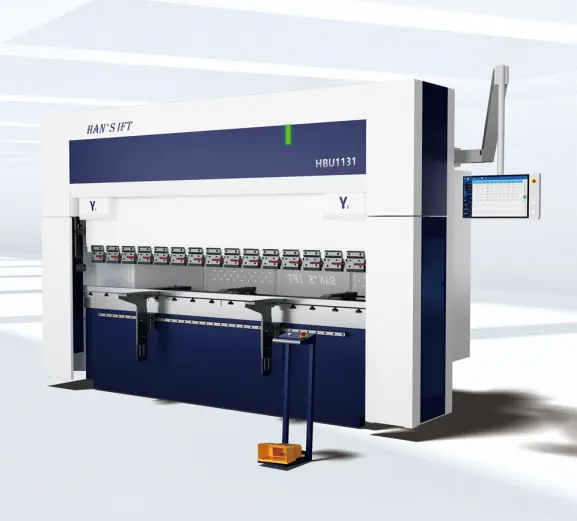
HBU Series: High-Performance Dual Servo Hybrid CNC Press Brake
Best for: Heavy-Duty Continuous Production
For manufacturers requiring maximum productivity and machine durability, the Han's HBU Series Dual Servo Hybrid CNC Press Brake provides a high-performance solution designed for demanding industrial environments.
Built on a reinforced machine structure and intelligent dual-servo drive architecture, the HBU Series delivers both efficiency and long-term reliability.
Key Advantages
•Ultra-Rigid Body:Precision-machined and reinforced structure ensures superior stability, durability, and bending accuracy.
•Integrated Hydraulic System:Optimized design reduces oil usage by over 60% while ensuring reliable long-term operation.
•Dual Servo Intelligent Drive:Improves processing efficiency by approximately 30% and achieves up to 70% oil savings.
•Comprehensive Safety Design:Integrated safety features and intelligent support systems promote safer and more efficient production.
Typical Applications
•Industrial equipment manufacturing
•Steel processing
•Heavy fabrication workshops
•Machinery component production
The HBU Series is particularly suitable for manufacturers seeking higher throughput while maintaining excellent bending quality.
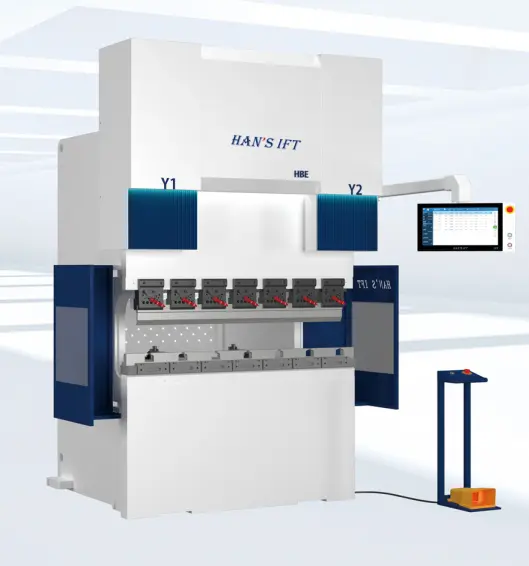
HBE Series: All-Electric Servo CNC Press Brake
Best for: Precision Manufacturing and Clean Production Environments
All-electric press brakes represent one of the most advanced developments in modern sheet metal bending technology.
The Han's HBE Series All-Electric Servo CNC Press Brake eliminates hydraulic systems entirely and utilizes precision servo motors combined with direct-drive transmission technology.
Key Advantages
•Environmental Protection:Servo-driven system eliminates hydraulic oil usage, reducing waste disposal and enabling cleaner, eco-friendly production.
•Energy Efficiency:Power consumption is dynamically adjusted according to load demand, with near-zero usage during standby for significant energy savings.
•High Efficiency:Direct-drive servo ball screw system delivers fast response and adjustable bending speeds, achieving up to 1–2x higher productivity than hydraulic machines.
•Precision:Advanced motion control and roller screw technology ensure micron-level positioning accuracy and long-term stability.
•Reliability:Simplified mechanical structure eliminates oil leakage risks, reduces maintenance needs, and ensures long-term low failure operation.
Because energy is supplied only when required, all-electric technology significantly reduces unnecessary power consumption while delivering exceptional precision.
Typical Applications
•3C Consumer electronics
•Semiconductor manufacturing
•Precision hardware
•Medical devices
•High-End Switchgear & Related Industries
As manufacturers pursue cleaner production and higher quality standards, electric press brakes are becoming increasingly popular worldwide.
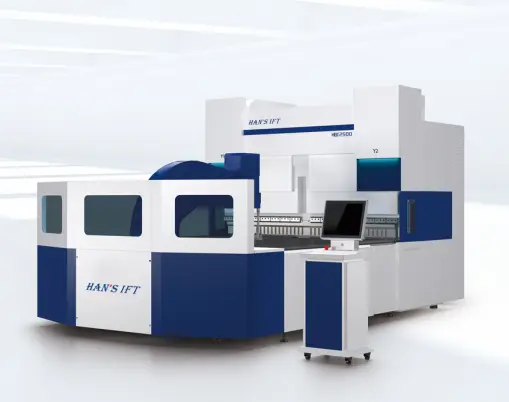
HBI Series: Multi-Sided Bending Center
Best for: Automated High-Volume Production
Traditional press brakes require multiple setups and repositioning steps when processing complex parts.
The Han's HBI Series Multi-Sided Bending Center addresses these challenges through automated multi-axis control and intelligent positioning technology.
Key Advantages
•CNC Auto-Positioning:Multi-axis synchronized motion enables multi-edge, multi-pass bending in a single setup, significantly reducing cycle time and increasing efficiency by 2–3 times compared with conventional press brakes.
•Automation-Driven:Integrated feeding and bending system minimizes manual intervention, reduces labor intensity, and lowers overall workforce costs.
•Versatile Tooling:Supports multiple processes such as flattening, arc bending, return bends, and flanging in a single die setup, reducing the need for custom tooling and improving production flexibility.
•Precision Clamping:Auto-aligned sheet positioning with stable, wrinkle-free clamping ensures high dimensional accuracy and consistent part quality for mass production.
Typical Applications
•Electrical cabinets
•Elevator panels
•Office furniture
•Home appliances
•Industrial enclosures
For manufacturers focused on productivity and labor reduction, bending centers offer a highly attractive alternative to traditional press brake operations.
Robotized Bending Automation Cell
Best for: Smart Manufacturing and 24/7 Production
Labor shortages and rising labor costs are driving increased demand for automation across the manufacturing sector.
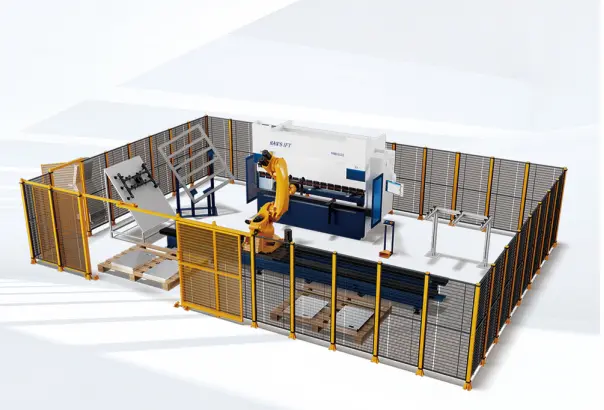
The Han's Robotized Bending Automation Cell combines CNC press brakes with industrial robots to create a fully automated bending process.
Key Advantages
•Automated Sheet Handling:Integrates CNC press brakes with robotics for automatic loading, rotation, centering, bending, and palletizing.
•24/7 High-Volume Production:Reduces manual labor, improves efficiency with up to 30% cycle time reduction, and lowers overall operating costs.
•Flexible Configurations:Supports both fixed and mobile robot setups, allowing customized bending cells for different production workflows.
•Smart Factory Integration:Seamlessly connects with laser cutting FMS and other systems to build fully automated sheet metal production lines.
When integrated with laser cutting systems and factory management software, robotic bending cells become a key component of smart factory operations.
Tandem Press Brakes
Best for: Extra-Long Workpieces
Some industries require processing components that exceed the capacity of a single press brake.
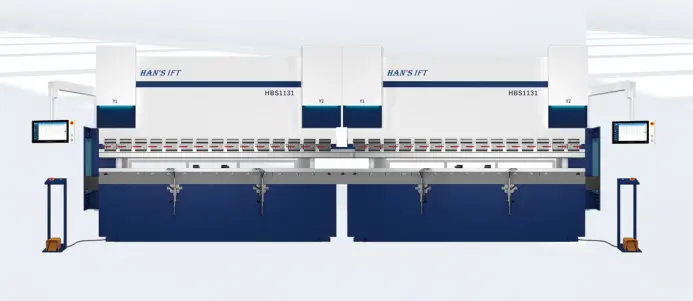
Han's Tandem Press Brakes synchronize multiple machines to function as one large bending system while retaining the flexibility to operate independently when needed.
Key Advantages
•Flexible Operation Modes:Supports both collaborative and standalone operation, providing greater flexibility for processing different materials and complex geometries.
•Deflection Compensation:Robust compensation system ensures stable linearity and consistent angular accuracy across large workpieces.
•Wide Industry Applications:Ideal for oversized components used in light poles, automotive structures, renewable energy equipment, and steel fabrication industries.
Typical Applications
•Light poles
•Steel structures
•Transportation equipment
•Renewable energy components
Tandem systems provide an efficient solution for manufacturers handling long and complex structural parts.
Heavy-Duty Press Brakes
Best for: Thick Plate and Large Structural Components
Heavy industries require machines capable of generating enormous bending forces while maintaining high precision.
Han's Heavy-Duty Press Brakes are specifically designed for these demanding applications.
Key Advantages
•Structural Integrity:High-rigidity frame optimized via finite element analysis (FEA) ensures stable long-term operation under heavy loads and high-speed conditions.
•Enhanced Capacity:Extended open height and stroke with customizable throat depth provide reliable performance for large-format and heavy-gauge sheet metal processing.
•Energy-Saving Hydraulics:Optimized hydraulic system maintains stable pressure and flow while reducing overall energy consumption.
•Precision Compensation:Heavy-duty worktable system compensates for deflection deformation, ensuring consistent bend straightness and angular accuracy.
Typical Applications
•Wind tower manufacturing
•Shipbuilding
•Construction machinery
•Mining equipment
•Heavy steel fabrication
These machines provide the strength and reliability required for large-scale industrial projects.
Choosing the Right Press Brake for Your Business
The ideal bending solution depends on your production requirements:
|
Requirement |
Recommended Solution |
|
General fabrication |
HBS Electro-Hydraulic Servo Press Brake |
|
Energy savings |
HBD Hybrid Servo Press Brake |
|
High-performance continuous production |
HBU Hybrid Servo Press Brake |
|
Precision manufacturing |
HBE All-Electric Press Brake |
|
High-volume automation |
HBI Bending Center |
|
Smart factory production |
Robotized Bending Automation Cell |
|
Extra-long workpieces |
Tandem Press Brake |
|
Thick plate processing |
Heavy-Duty Press Brake |
Conclusion
Modern sheet metal fabrication requires precision, automation, energy efficiency, and intelligent control. Han's offers a complete portfolio of intelligent bending solutions—from the HBS electro-hydraulic servo, HBD/HBU hybrid servo, and HBE all-electric press brakes to the HBI bending center and robotized automation cell. Choosing the right press brake technology helps manufacturers boost productivity, cut operating costs, enhance quality, and prepare for smart manufacturing.
FAQ: Common Questions About type of press brakes
1. What are the main types of press brakes available today?
The main types of press brakes include hydraulic press brakes, electro-hydraulic servo press brakes, hybrid servo press brakes, all-electric press brakes, bending centers, tandem press brakes, heavy-duty press brakes, and robotic bending automation cells.
2. What is the difference between hydraulic, hybrid, and electric press brakes?
Hydraulic press brakes provide strong bending force and versatility, hybrid press brakes improve energy efficiency by combining servo and hydraulic technology, while electric press brakes use servo motors for higher precision, faster speed, and oil-free operation.
3. What is a bending center used for?
A bending center is an automated sheet metal forming system that performs multi-side bending in a single setup. It significantly improves production efficiency, reduces manual labor, and is ideal for high-volume manufacturing such as cabinets, appliances, and enclosures.
4. How does an intelligent CNC system improve press brake performance?
An intelligent CNC system automates bending calculations, deflection compensation, collision avoidance, and programming. With 3D model import and smart nesting (such as HBEND-3D), it improves accuracy, reduces operator dependency, and enables smart factory integration.


 Previous


 LET’S TALK


